Houses & House Systems · 10 min read
The 12 Houses of Astrology: What Each House Means in Your Chart
The 12 houses divide your birth chart into areas of life: self, money, home, love, work, partners, career and more. What each one means, in modern and traditional astrology.
By Celestio ·
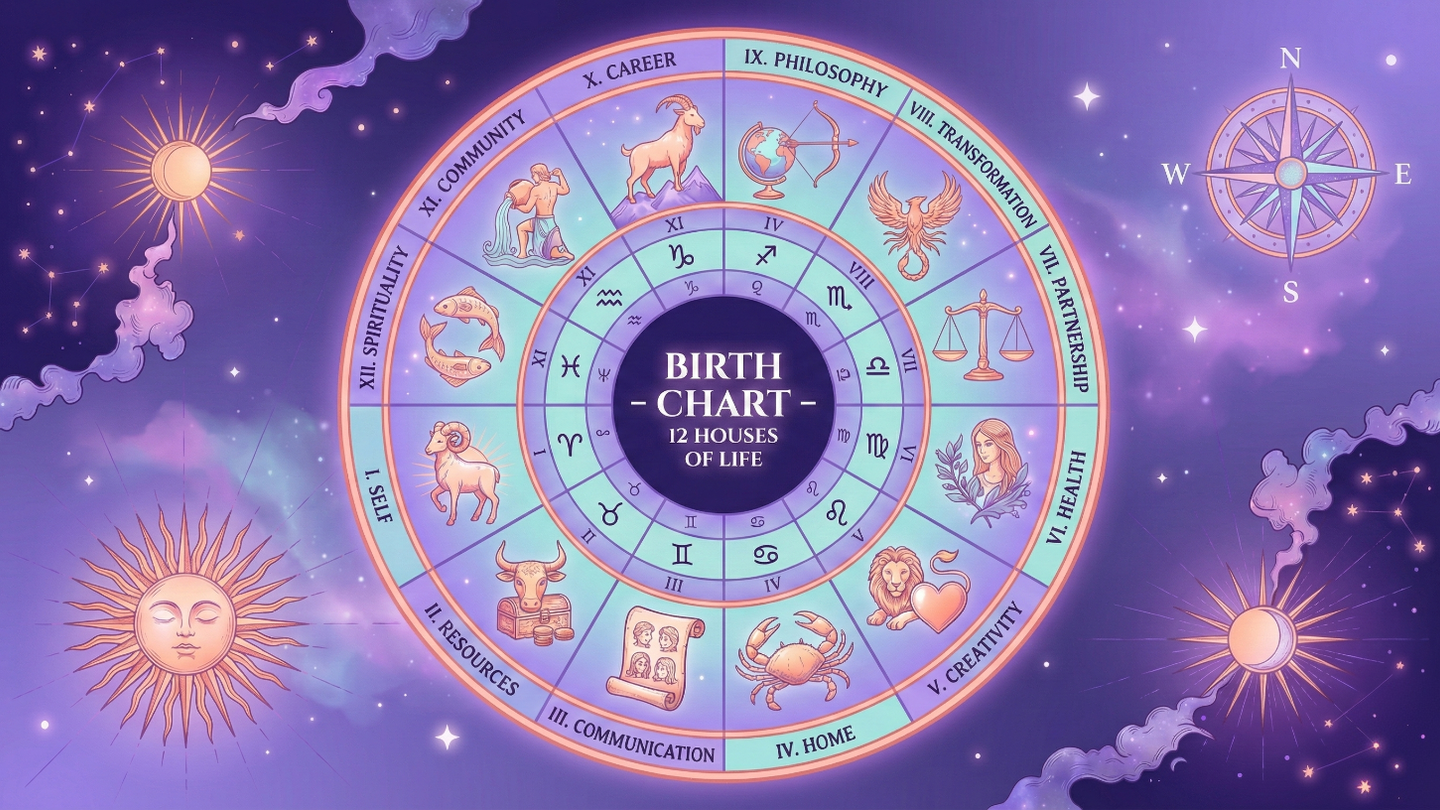
The 12 houses of astrology divide your birth chart into twelve areas of life, from your body and money to your partners, career and private inner world. Planets show what kind of energy is at work, signs show how it behaves, and the house a planet sits in shows where in your life it plays out.
The houses are the most personal layer of a chart. Everyone born on the same day shares roughly the same planets in the same signs, but the houses depend on the exact minute and place of birth. Two people with a Libra Sun can have it in the 1st house, where it shapes how they come across, or in the 10th, where it shapes their work and reputation. That difference is the houses.
How the houses are drawn
The houses are drawn from your local horizon and meridian at the moment of birth. The Ascendant, the degree of the zodiac rising in the east, starts the 1st house. The IC, the lowest point under your feet, starts the 4th. The Descendant, setting in the west, starts the 7th, and the Midheaven, the zodiac's crossing of the meridian overhead, starts the 10th. These four points are the angles of the chart.
Because the sky turns a full circle every day, the angles move through all twelve signs in about 24 hours. A new degree rises roughly every four minutes, which is why the houses need an accurate birth time. Without one, the signs of your planets still hold, but the houses cannot be fixed; our guide to a birth chart without a birth time shows what you can read anyway.
How the space between the angles is divided depends on the house system. Placidus, the most widely used system in modern Western astrology, divides it by time, so houses come out in different sizes. Whole Sign, the oldest surviving system, makes each sign one house. Celestio draws your chart in Placidus, and in Whole Sign houses at very high latitudes, where Placidus cannot be drawn. If another site puts one of your planets in a different house, the system is usually why: see Whole Sign vs Placidus houses and Placidus and other house systems.
Angular, succedent and cadent houses
The twelve houses fall into three groups of four, and the group tells you how strongly a house acts.
- Angular houses (1st, 4th, 7th, 10th) begin at the four angles. They are the most active and visible places in a chart. A planet here tends to be loud: people notice it, and it shapes events.
- Succedent houses (2nd, 5th, 8th, 11th) follow the angles. Their themes are what you build up and keep: resources, children and creations, inheritances, friends and allies.
- Cadent houses (3rd, 6th, 9th, 12th) "fall away" from the angles. Traditional astrologers considered them weaker places, where planets act less directly. Modern astrologers read them as the houses of learning, adjustment and inner life.
Hellenistic astrologers added a second test. A house that makes no classical aspect to the rising sign was said to be "in aversion" to it, unable to see the self. The 2nd, 6th, 8th and 12th are in aversion to the 1st, and three of them (the 6th, 8th and 12th) became the old "difficult" houses. Modern astrology softens that language, but it explains why those houses carry their reputation for hard lessons.
What each of the 12 houses means
Each house below gives the meaning most modern astrologers use, then the older emphasis where it differs. Both are worth knowing: the modern meanings are what most chart sites show you, and the traditional ones often explain where those meanings came from.
1st house: self and body
The 1st house is you: your body, vitality, temperament and the way you meet the world. Planets here colour your manner and first impressions strongly. Traditionally it was called the "Helm", the part of the chart that steers the life, and it stood for life itself.
2nd house: money and resources
The 2nd house covers what you own and live on: income, possessions, earning skills and material security. The modern emphasis on "self-worth" and "values" is a 20th-century addition; older astrologers read this house as livelihood, plain and practical.
3rd house: communication and siblings
The 3rd house rules everyday thinking and talk, siblings, neighbours, short journeys and early schooling. Hellenistic astrologers also called it the house of the "Goddess", the Moon's place, and linked it to religious rites and ritual, a meaning modern texts have mostly dropped.
4th house: home and roots
The 4th house rules home, family, ancestry, land and private life, and the foundations you return to. Traditionally it also signified parents (often the father) and the end of things, how a matter concludes. The modern "nurture and belonging" tone comes from its link with Cancer.
5th house: pleasure, creativity and children
The 5th house covers play, creativity, romance, dating, pleasure and children. Traditionally it was "Good Fortune", the place of Venus's joy, and its first meaning was children. Its modern fame as the "romance house" is real but newer, and it describes the delight of falling for someone rather than commitment.
6th house: work, health and routine
The 6th house rules daily work, routines, health habits, service, coworkers and small animals. Older astrologers were blunter: this was "Bad Fortune", Mars's joy, the house of illness, injury, servitude and hardship. The modern reading of wellness and good habits grew out of that older idea of daily strain and its upkeep.
7th house: partners and others
The 7th house rules partnership: marriage, committed relationships, business partners and anyone who meets you one-to-one. Medieval astrologers added contracts, lawsuits and "open enemies", the rivals you know by name. Our 7th house guide goes further into the Descendant and partners.
8th house: shared resources and endings
The 8th house covers other people's money, debts and inheritances, intimacy and trust, crisis and endings. In older texts it was simply the house of death and inheritance. The modern themes of sex, psychology and transformation are mostly 20th-century, drawn from its link with Scorpio and Pluto.
9th house: beliefs, travel and study
The 9th house rules philosophy, religion, higher learning, long journeys, foreign places and publishing. Traditionally it was "God", the place of the Sun's joy, with dreams and divination added. Its meaning has stayed close to the original for two thousand years.
10th house: career and reputation
The 10th house rules career, public standing, honours and what you are known for. Hellenistic astrologers called it the house of praxis, action: what you do and the status it earns. In Placidus, the Midheaven begins the 10th house; in Whole Sign, the Midheaven can fall in the 9th, 10th or 11th.
11th house: friends and allies
The 11th house rules friends, groups, communities, hopes and the support you receive. Traditionally it was the "Good Spirit", Jupiter's joy, the house of benefactors and gains. Its modern humanitarian, Aquarian tone is an overlay on that older idea of good company.
12th house: the hidden and the private
The 12th house rules solitude, retreat, the unseen and the unconscious, and places set apart from daily life. Older astrologers called it the "Bad Spirit", Saturn's joy, a place of secret enemies, loss and confinement. The modern reading of spirituality and inner depth is a gentler lens on the same theme: what happens out of view.
Read your own chart
Enter a birth date and place for a chart calculated for that moment, and a reading written for it. Free, and the birth time is optional.
Read your chartThe joys of the planets
Hellenistic astrologers gave each of the seven classical planets a house where it "rejoices", where its nature is most at home. The list is consistent across the ancient sources:
- Mercury rejoices in the 1st house, the Helm.
- The Moon rejoices in the 3rd, the Goddess.
- Venus rejoices in the 5th, Good Fortune.
- Mars rejoices in the 6th, Bad Fortune.
- The Sun rejoices in the 9th, God.
- Jupiter rejoices in the 11th, the Good Spirit.
- Saturn rejoices in the 12th, the Bad Spirit.
The pattern is elegant. The day planets (Sun, Jupiter, Saturn) rejoice in houses above the horizon, the night planets (Moon, Venus, Mars) below it, and Mercury, which can belong to either, on the horizon itself. The astrologer Chris Brennan argues that the joys helped create the house meanings: Venus's joy is why the 5th is about pleasure and children, and the Moon's joy is why the 3rd once meant religious rites.
Houses are not signs
One popular shortcut equates the 1st house with Aries, the 2nd with Taurus and so on round the wheel. This "twelve-letter alphabet" is a 20th-century teaching device, and it causes real confusion. Houses and signs grew from different principles: signs are sections of the zodiac, houses are sections of the local sky. The historian and astrologer Deborah Houlding shows in The Houses: Temples of the Sky that the house meanings came from the angles, the joys and the aspects to the Ascendant, not from the signs. Use the analogy as a memory aid at most. A planet in your 8th house is not "in Scorpio", and Mars in your 1st house does not make you an Aries.
How to read a planet in a house
The simplest method is planet + sign + house: what, how and where. Saturn is effort, structure and responsibility. In Cancer it works through care and protection. In the 4th house it shows up at home and in the family.
Put together, someone with Saturn in Cancer in the 4th house often takes on responsibility at home early, or builds a home with great seriousness and care. A traditional astrologer would add that Saturn is in its detriment in Cancer and that the 4th describes parents and foundations, so the placement often points to a parent who carried weight, or a home built slowly and solidly. Read with the modern and traditional meanings side by side, the placement tells a fuller story than either alone. Our guide to the planet, sign and house formula works through more examples.
Two notes help you avoid the usual traps. A house with no planets in it is not missing from your life: read it through the sign on its cusp and that sign's ruling planet, as the empty houses guide explains. A house with several planets is a focus of energy and attention, not a sign of trouble.
Frequently asked questions
What are the 12 houses in astrology?
The 12 houses in astrology are twelve divisions of the birth chart, each ruling an area of life: self, resources, communication, home, pleasure, work and health, partnership, shared resources, beliefs, career, friends and the hidden life. They are drawn from your birth time and place, so they are the most personal part of the chart.
Which house is the most important in a birth chart?
The four angular houses (the 1st, 4th, 7th and 10th) are the most powerful, because they begin at the chart's four angles. The 1st house matters most of all, since it starts at the Ascendant and describes your body and approach to life. Planets close to any angle are the most visible in a chart.
Why are my houses different on another astrology site?
Different sites use different house systems. Placidus divides the sky by time, so its houses vary in size; Whole Sign makes each sign one house. A planet near a house boundary can change house between the two. Your planets' signs stay the same. A wrong birth time or time zone can also shift every house.
Do I need my birth time to know my houses?
Yes. The houses depend on the degree rising at the moment of birth, which changes about every four minutes, so even a small time error can move the house cusps. Without a time, you can still read your planets' signs and the aspects between them, but not which house each planet occupies.
What is the difference between houses and signs?
Signs and houses answer different questions. The twelve signs are sections of the zodiac and describe how a planet behaves, its style. The twelve houses are sections of the local sky at your birth and describe where in life that planet acts. The 1st house is not the same thing as Aries, even though the two are often paired.
See your houses
Your houses turn a list of placements into a life: where your energy goes, what you build and whom you build it with. Enter your birth date, time and place in your free birth chart to see which house each of your planets falls in, with a reading written for that exact chart.
Celestio