Astrology Basics · 8 min read
North Node and South Node: The Lunar Nodes Explained
The lunar nodes are the two points where the Moon's path crosses the Sun's. What the North and South Node mean in your chart, true vs mean node, and the 18.6-year nodal cycle.
By Celestio ·
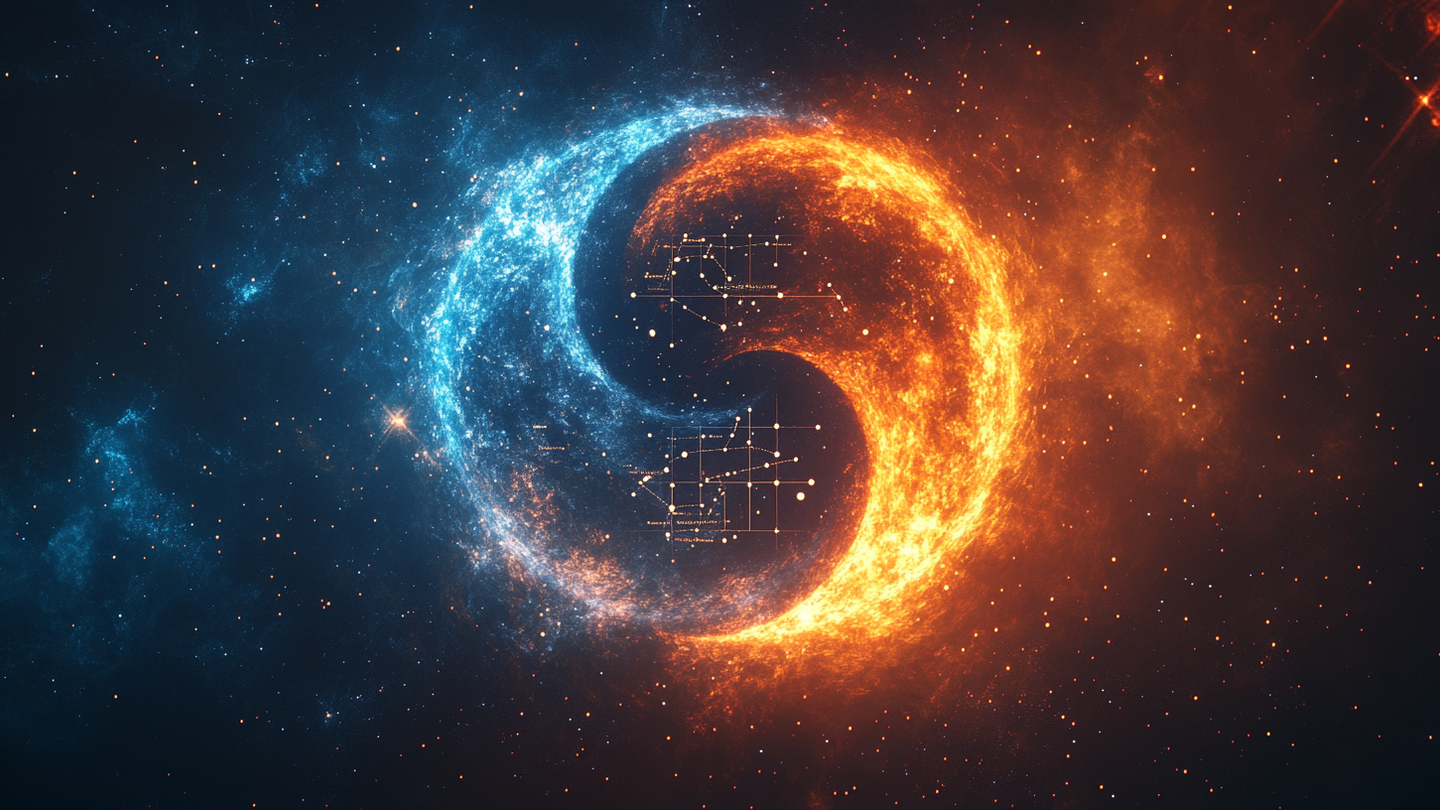
The North Node and South Node are the two points where the Moon's orbit crosses the ecliptic, the Sun's apparent path through the zodiac. They always sit exactly opposite each other, so your chart has them in opposite signs and, with a birth time, opposite houses. Modern astrologers read the South Node as what comes naturally to you and the North Node as the direction you grow toward.
The nodes are not planets. They are points in space, and they matter in astronomy too, because eclipses happen only when a New or Full Moon falls close to them. That link to eclipses is why astrologers have watched them for more than two thousand years, and why every tradition gives them weight, even though the traditions read them very differently.
What the lunar nodes are
The Moon's orbit is tilted about 5° to the ecliptic, so twice a month the Moon crosses it. The point where it crosses heading north is the North Node, also called the ascending node; the point where it crosses heading south is the South Node, or descending node.
The line between the two nodes moves slowly backwards through the zodiac, about 19.3° a year, and completes a full circle in about 18.6 years. That means the nodes spend roughly 18 to 19 months in each pair of signs, and everyone born within that window shares the same node signs. Their house placement, and any planets close to them, make them personal.
This 18.6-year nodal cycle is not the Saros eclipse cycle of about 18 years and 11 days, though the two are often confused.
True node or mean node
Your chart shows one of two calculations, and they can differ by a degree or more.
- The mean node is a smoothed average position. It always moves backwards, which is why the nodes are often described as always retrograde.
- The true node follows the Moon's actual orbit from moment to moment. It wobbles back and forth around the mean position and occasionally moves forward for a short time.
Neither is wrong. Both are models of a moving orbit, and even the true node is exactly true only twice a month, when the Moon actually crosses the ecliptic. Vedic astrologers traditionally use the mean node; much Western software defaults to the true node. The difference matters only when your node sits within a degree or two of a sign or house boundary, so check which one your chart uses before you compare two charts.
Three ways astrologers read the nodes
The nodes are one of the places where astrology's traditions part company most clearly.
Traditional Western astrology called them the Dragon's Head (Caput Draconis, the North Node) and the Dragon's Tail (Cauda Draconis, the South Node). The Head was treated as benefic, Jupiter-like, and the Tail as malefic, Saturn-like. Medieval authors such as Abu Ma'shar taught a simpler rule: the North Node increases whatever planet it touches, and the South Node diminishes it.
Vedic astrology calls them Rahu (North) and Ketu (South), the head and body of the demon Svarbhanu, cut in two after he drank the nectar of immortality. Both are counted among the nine grahas, the bodies that shape a chart. Rahu is linked with appetite and worldly ambition, Ketu with detachment and the spiritual.
Modern evolutionary astrology, developed by Jeffrey Wolf Green and Steven Forrest, reads the South Node as patterns you were born with, which some in this school see as past lives, and the North Node as the soul's direction of growth. This is the reading most people meet first today. It is a 20th-century approach, one school among several. Other astrologers, including Glenn Perry, question the past-life link, and many who use the nodes read them for growth without any claim about past lives.
Read your own chart
Enter a birth date and place for a chart calculated for that moment, and a reading written for it. Free, and the birth time is optional.
Read your chartHow we read them: what is familiar and what is next
In practice, most astrologers today read the nodal axis as a line of growth between two opposite sides of life, and that is how we read it here.
The South Node shows what is familiar: skills and habits that feel like home, the way you act when you are tired or under pressure. It is a strength. It becomes a rut only when it is the only thing you do.
The North Node shows what is next: qualities that feel awkward at first and rewarding once you practise them. You do not leave the South Node behind; you bring its skills with you while you grow toward the opposite sign.
Because the two signs are opposites, each axis is one balance seen from two ends.
The nodes through the signs
Each nodal axis pairs two opposite signs. The sign of your North Node names what you are growing toward.
Aries and Libra
North Node in Aries: you know how to keep the peace and read a room; your growth is in saying what you want and acting on it without waiting for approval. North Node in Libra: you know how to act alone and fast; your growth is in partnership, listening and building something with another person.
Taurus and Scorpio
North Node in Taurus: you know intensity, crisis and depth; your growth is in steadiness, simple pleasures and trusting that calm can be meaningful. North Node in Scorpio: you know comfort and security; your growth is in intimacy, shared resources and letting things change.
Gemini and Sagittarius
North Node in Gemini: you know big beliefs and the big picture; your growth is in curiosity, questions and the details close at hand. North Node in Sagittarius: you know how to gather information and talk; your growth is in committing to a view and finding meaning in it.
Cancer and Capricorn
North Node in Cancer: you know how to achieve and hold things together; your growth is in feeling, home and letting yourself be cared for. North Node in Capricorn: you know how to nurture and create safety; your growth is in ambition, responsibility and building something that lasts in the world.
Leo and Aquarius
North Node in Leo: you know groups, causes and ideas; your growth is in creating, being seen and leading from the heart. North Node in Aquarius: you know how to shine on your own; your growth is in shared purpose, friendship and contributing to something bigger.
Virgo and Pisces
North Node in Virgo: you know imagination and the spiritual; your growth is in practical skill, routine and useful service. North Node in Pisces: you know how to analyse, organise and fix; your growth is in trust, imagination and letting some things be.
The nodes in the houses
With a birth time, the nodes fall in two opposite houses, and those houses show where in life the balance plays out. North Node in the 7th and South Node in the 1st: growth comes through partnership, from a base of independence. North Node in the 10th and South Node in the 4th: growth comes through career and public life, from a base of home and family. North Node in the 12th and South Node in the 6th: growth comes through rest, solitude and inner life, from a base of work and routine.
The 12 houses gives each house's meaning, so you can read any pair the same way. Two more layers add detail:
- Planets within a few degrees of a node are emphasised. The North Node tends to amplify a planet it touches; the South Node tends to quieten or internalise it.
- The ruler of the North Node's sign shows, by its own sign and house, how that growth tends to happen, much as the chart ruler does for the chart as a whole.
Nodal returns
Because the nodes circle the zodiac in about 18.6 years, they return to their birth positions at regular ages. These are the nodal returns:
- about 18 years 7 months;
- about 37 years 2 months;
- about 55 years 10 months;
- about 74 years 5 months.
Halfway between them, at about 9, 28, 46 and 65, the nodes reach the opposite positions, North Node over your natal South Node: the reverse nodal return. Astrologers watch both as times when questions of direction come up again. Because eclipses happen when a New or Full Moon falls near the nodes, the eclipses of the year around a return fall close to your natal nodal axis.
These are transits, like the Saturn return, and their timing is set by the sky, so everyone of the same age meets them together. The houses involved make each one personal.
Frequently asked questions
What do the North Node and South Node mean in astrology?
The North Node and South Node are the two points where the Moon's orbit crosses the Sun's path, always opposite each other. In modern astrology the South Node shows what comes naturally, familiar skills and habits, and the North Node shows the direction of growth, qualities that feel new but rewarding. Traditional astrology read the North Node as increasing and the South Node as diminishing what they touch.
What is the difference between true node and mean node?
The true node and mean node are two calculations of the lunar nodes. The mean node is a smoothed average that always moves backwards; the true node follows the Moon's actual orbit and wobbles around the mean, sometimes moving forward briefly. They can differ by a degree or more, enough now and then to put the node in a different sign or house. Vedic astrology traditionally uses the mean node; many Western programs default to the true node.
Is the North Node my life purpose?
The North Node is read by modern astrologers as a direction of growth rather than a fixed life purpose. It describes qualities that feel unfamiliar and pay off when you develop them, balanced against the familiar strengths of the South Node. Evolutionary astrology goes further and links the nodes to the soul's path across lives; traditional and Vedic astrology read them differently.
Why are the North Node and South Node always opposite?
The North Node and South Node are always opposite because they are the two ends of one line: the line where the Moon's tilted orbit meets the plane of the ecliptic. The Moon crosses northward at one end and southward at the other, exactly 180° apart. So the nodes are always in opposite signs, and in opposite houses when the birth time is known.
When is my nodal return?
A nodal return happens when the transiting lunar nodes come back to their positions in your birth chart, about every 18.6 years: near ages 18 years 7 months, 37 years 2 months, 55 years 10 months and 74 years 5 months. The reverse nodal return, with the North Node on your natal South Node, falls halfway between, at about 9, 28, 46 and 65.
Find your nodes
Draw your birth chart to see your North and South Node by sign and house, with the rest of the chart around them. The planet, sign and house formula works for the nodes too: read the axis, then the sign, then the houses.
Celestio