Love, Relationships & Synastry · 7 min read
Birth Chart Compatibility vs Zodiac Signs: Why Sun Signs Aren't Enough
Sun-sign compatibility compares one placement each. Birth chart compatibility reads both whole charts. How the two differ, and how to move from your Sun pair to your Moon and Venus pairs.
By Celestio ·

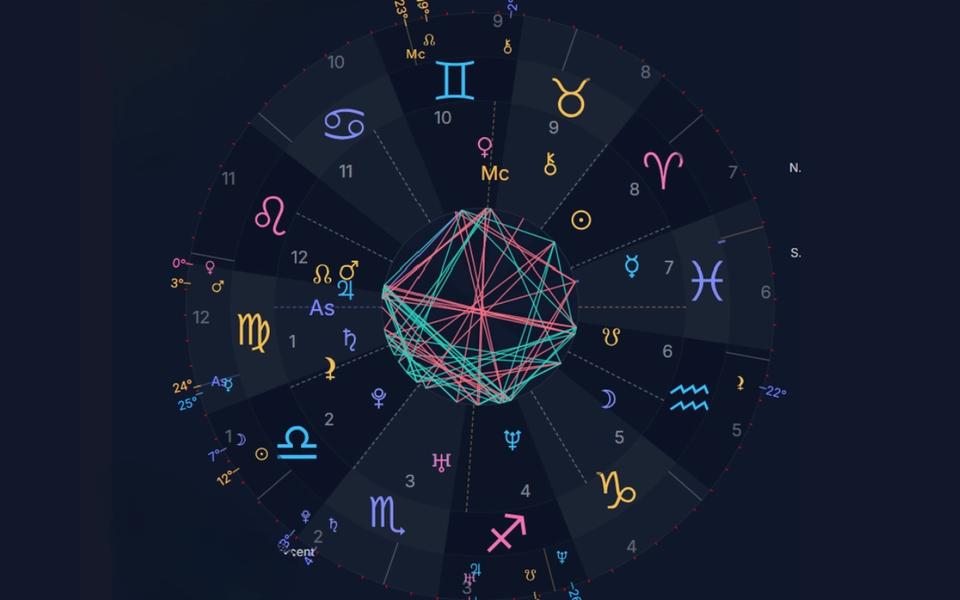
Zodiac compatibility compares two Sun signs; birth chart compatibility compares two whole charts. A Sun-sign match looks at one placement per person, out of 144 possible pairings. Birth chart compatibility, which astrologers call synastry, reads the Moon, Venus, Mars, Mercury, Saturn and the angles of both charts, degree by degree, so two Aries–Libra couples can come out completely different.
If you have ever looked up "are Scorpio and Leo compatible" and thought the answer missed something, it did. The Sun sign is real and it matters. It is just one voice in a room of a dozen, and astrologers have known that for a very long time.
What Sun-sign compatibility claims
Sun-sign compatibility tables rest on a few simple rules about elements and modes.
- Same element (fire with fire, water with water) is called easy and natural. These signs are a trine apart, or the same sign.
- Complementary elements (fire with air, earth with water) are called supportive or magnetic. These signs are a sextile or an opposition apart.
- Signs of the same mode that square each other, such as cardinal Aries and Cancer or fixed Taurus and Leo, are called friction-prone.
These rules are not invented. They are the old doctrine of aspects, applied to whole signs. Ptolemy called trines and sextiles harmonious and squares and oppositions disharmonious, partly because harmonious signs share the same gender (masculine or feminine). The tables simply take that logic and apply it to one planet: the Sun.
Why astrologers never stopped at the Sun
Even the oldest compatibility technique on record looks well past the Sun. In the Tetrabiblos, Ptolemy judged marriage by how the Sun and Moon of both people relate, and he gave special weight to one partner's Moon meeting the other's Sun. For friendship, he compared the Sun, Moon, Ascendant and Lot of Fortune of both charts. Sun-sign matching, by contrast, is a 20th-century shorthand that grew out of newspaper horoscope columns.
Modern practitioners agree. Stephen Arroyo, one of the best-known writers on relationship astrology, compared couples by the elements of their Moon, Venus, Mars and Ascendant, not the Sun alone. And the one large test of pure Sun-sign matching agrees with them. The sociologist David Voas studied the 2001 census of England and Wales, more than ten million married couples, and found that no Sun-sign pairing married more often than chance would predict. Astrologers took that as confirmation of what they already practise: compatibility lives in the whole chart, not in one line of it.
What birth chart compatibility reads instead
When astrologers compare two charts, these are the placements that do most of the work:
- The Moon: emotional needs, daily rhythm, what makes each of you feel safe. Two Moons decide what an ordinary Tuesday evening feels like.
- Venus: what each of you finds beautiful and how you show affection. Mismatched Venus signs are why one person can feel loved and the other unnoticed.
- Mars: desire, drive and how you fight. Two Mars signs describe whether arguments flare and fade or simmer for days.
- Mercury: how you talk, plan and repair misunderstandings.
- The Ascendant and Descendant: first impressions, and the kind of partner each of you is drawn to.
- Saturn: commitment and staying power, and also where one of you can feel judged.
Each of these is read as an aspect between the two charts, at the level of degrees, and in both directions. Your Moon square their Venus is not the same as their Moon square your Venus. The synastry guide explains the method in full.
See how you two fit
Enter two birth dates and places. See your strongest connections free, then read the full compatibility report written for the two of you.
Compare chartsA worked example: the same Sun signs, two stories
Take two couples who both have an Aries Sun and a Libra Sun. By the tables, both are an "opposites attract" opposition.
In the first couple, she has the Sun in Aries and the Moon in Cancer; he has the Sun in Libra and the Moon in Capricorn. Her Cancer Moon squares his Libra Sun and opposes his Capricorn Moon. She needs closeness and reassurance; he needs order and some quiet. Both Moon contacts are the kind Ptolemy called disharmonious, so this couple will feel the opposition in daily life, not just on paper. An astrologer would then look for what softens it: a Venus–Moon trine, Ascendants in the same element, or a kindly Jupiter touching either Moon.
In the second couple, she has the Sun in Aries and the Moon in Leo; he has the Sun in Libra and the Moon in Sagittarius. Now both Moons are fire, a trine apart, and her Leo Moon sextiles his Libra Sun. The same Sun-sign opposition sits on top of real emotional ease. They tease, they sharpen each other, and they recover quickly.
Same tables, same verdict, two different relationships. The difference is entirely below the Sun.
How to go beyond your Sun signs
You can move from Sun-sign compatibility to a fuller picture in a few minutes, as long as you have both birth dates.
- Look up both Moon signs. Compare them the way you would compare Sun signs: same element, complementary element or square.
- Do the same for both Venus signs. This tells you whether affection lands easily.
- Compare her Venus with his Mars, and his Venus with her Mars. These describe attraction in each direction.
- Check each person's Moon against the other's Sun, Ptolemy's oldest test.
- If you know both birth times, compare the Ascendants and see whose planets fall near the other's Descendant.
Sign-to-sign comparison is the quick version. A full reading uses the exact degrees, because a Moon at 29° Gemini and a Moon at 1° Cancer are in different signs but only 2° apart.
When the "wrong" signs work beautifully
Every astrologer has seen couples with "incompatible" Sun signs who are plainly happy together. The reason is almost always in the rest of the chart. An Aries and a Cancer, a square by Sun sign, may have their Moons a trine apart, his Mars in her Venus sign and a Saturn sextile that keeps them steady. The Sun-sign friction is there, a difference in pace and temperament, and it sits inside a relationship that feels safe and warm.
The reverse happens too. Two fire Suns can look ideal in a table and still struggle if one has the Moon in Capricorn and the other has the Moon in Aries. One wants a plan, the other wants to move now, and the shared Sun element does not settle it.
A comparison from Vedic astrology
Indian astrology has its own compatibility system, called Guna Milan or Ashtakoota. It compares eight factors, almost all of them drawn from the Moon's position. Two things about it are worth knowing. First, it is built on the Moon, not the Sun, which again shows how astrologers weigh emotional fit. Second, Vedic astrologers themselves look at the 7th house and the rest of both charts before they judge a match. Western synastry works the same way: it reads the contacts between two charts and describes them.
Frequently asked questions
Is Sun-sign compatibility accurate?
Sun-sign compatibility is the simplest form of astrological compatibility: it compares one placement for each person, using the elements and aspects between the two signs. Astrologers treat it as a first impression rather than a reading. A full birth chart comparison adds the Moon, Venus, Mars, Mercury, Saturn and the angles, which describe emotional fit, attraction, conversation and commitment.
Is Moon sign compatibility more important than Sun sign compatibility?
Moon sign compatibility carries more weight than Sun sign compatibility for most astrologers, because the Moon describes emotional needs and the texture of daily life together. The oldest compatibility technique, in Ptolemy's Tetrabiblos, already ranked the Moon alongside the Sun and paid special attention to one partner's Moon meeting the other's Sun. Vedic compatibility scoring is built almost entirely on the Moon.
Why do I get along with my "incompatible" sign?
You get along with an "incompatible" Sun sign because the rest of your two charts tells a different story. Your Moons may be in harmonious elements, your Venus and their Mars may form a trine, or a Saturn contact may keep things steady. Sun-sign tables only see one placement each, so they cannot see any of that.
Do I need a birth time for birth chart compatibility?
Birth chart compatibility works without birth times for most placements. The Sun, Mercury, Venus, Mars and the slower planets read from the birth date and place, and so do the aspects between them. Birth times add the Ascendant, Descendant and house overlays, and they fix the Moon's exact degree, which matters on days when the Moon changes sign.
Compare the whole charts
Your Sun signs got the conversation started. To see the rest, enter both birth dates and places in a compatibility report. It reads the two whole charts together and shows your strongest connections free: what draws you to each other, how each of you needs care and how you talk and disagree. If you have not read your own chart yet, start with your free birth chart. For the contacts that hold relationships together over years, read the best synastry aspects for long-term compatibility.

Celestio