Love, Relationships & Synastry · 8 min read
What Is Synastry? How Two Birth Charts Explain a Relationship
Synastry compares two whole birth charts to show how two people meet: the aspects between their planets, whose planet touches whose, and where each lands in the other's life.
By Celestio ·

Synastry is the astrological method of comparing two birth charts to describe how two people affect each other. It reads the aspects between one person's planets and the other's, and where each person's planets fall in the other's houses, so it can show why you feel calm with one friend and restless with another.
The word means "stars together". It is how astrologers answer the questions people actually bring to a relationship: why this person, why this feeling, why this argument again. It works for a partner, a crush, a best friend, a sibling or a parent, because any two charts can be laid side by side.
How synastry works
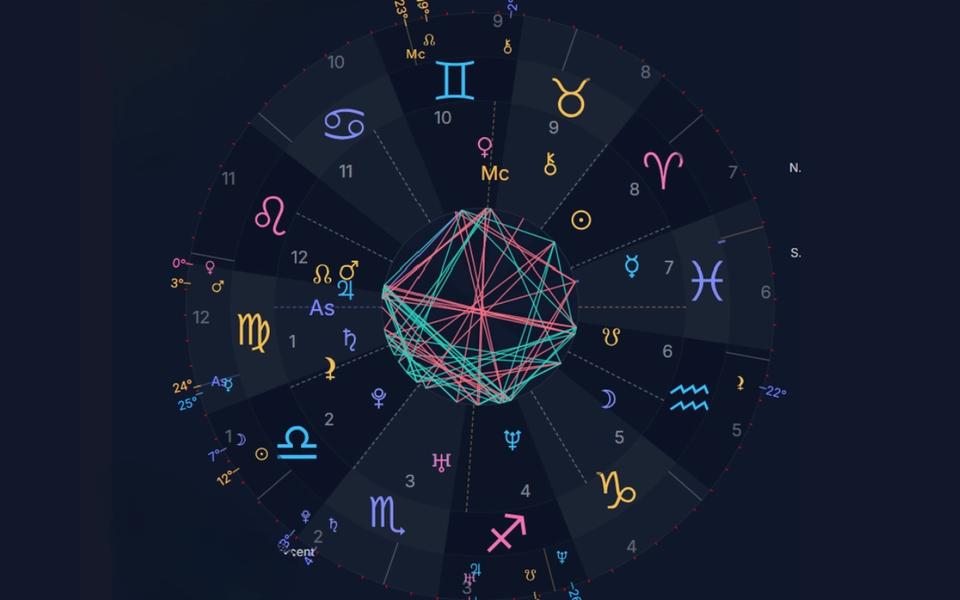
Synastry places one chart over the other, usually as a double wheel, with your chart inside and theirs around it. Then it reads two things.
- Inter-aspects: the angles between your planets and theirs. Your Venus 2° from their Mars is a conjunction; your Moon 90° from their Saturn is a square. The same five major aspects used in a single chart apply: conjunction (0°), sextile (60°), square (90°), trine (120°) and opposition (180°).
- House overlays: which of your houses their planets land in, and the reverse. Their Sun in your 7th house puts their whole presence in your area of partnership. House overlays have their own guide.
A useful image from relationship astrologers is that each person works like a permanent transit to the other's chart. Whatever their planets touch in you is what you feel when you are with them. If their Mars sits on your Mercury, conversations with them are quick, sharp and sometimes heated, because their drive keeps landing on the part of you that thinks and speaks.
Direction: whose planet touches whose
Every contact in synastry has a direction, and reading it is what separates a real reading from a list of aspects. Your Venus square their Mars is not the same as their Venus square your Mars.
In "my Venus, your Mars", you are the one who feels pursued, admired or rushed, and they are the one who feels drawn to your charm. Swap the planets and the roles swap too. The Saturn person in a Saturn contact tends to feel responsible or critical, while the other person feels steadied or held back. So a good synastry reading always asks two questions about each contact: what does it feel like to you, and what does it feel like to them?
This is also why a connection can feel lopsided. If three of your personal planets touch their Moon and almost nothing of theirs touches yours, you may feel the bond more strongly than they do, and synastry shows that plainly.
Synastry is older than you think
Comparing two charts is one of the oldest techniques in Western astrology, not a modern invention. In the Tetrabiblos, written in the 2nd century, Ptolemy judged marriages by how the two people's Sun and Moon relate. Marriages last, he wrote, when the luminaries are in harmonious aspect, especially "when the husband's moon is in such aspect with the wife's sun". In his chapter on friends and enemies, he compares the Sun, Moon, Ascendant and Lot of Fortune in both charts.
Ptolemy even sorted friendships by their source, a typology that still reads well today:
- Friendships formed through the Sun and Moon come "from choice", which he calls the best and surest kind.
- Friendships formed through the Lots of Fortune come "through need".
- Friendships formed through the Ascendants come "through pleasure or pain".
The modern form of synastry took shape in the 1970s. Books such as Liz Greene's Relating (1977), Ronald Davison's Synastry (1977) and Stephen Arroyo's Relationships and Life Cycles (1979) added a psychological lens: the idea that we often meet our own unlived qualities in the people we are drawn to. The composite chart, a separate technique, also comes from that decade. The composite chart vs synastry guide explains the difference.
See how you two fit
Enter two birth dates and places. See your strongest connections free, then read the full compatibility report written for the two of you.
Compare chartsWhat astrologers weigh most
Not every contact carries equal weight. Across traditions, astrologers give most attention to a handful of factors:
- The Sun and Moon: Sun–Moon, Moon–Moon and Moon–Ascendant contacts describe emotional fit, the thread that runs from Ptolemy to modern practice.
- Venus and Mars: attraction, affection and desire. The Venus–Mars synastry guide reads them in detail.
- Mercury: how you talk and argue, which matters more as a relationship settles. See Mercury in synastry.
- Saturn: commitment, duty and staying power, and also weight and criticism.
- The angles: the Ascendant, Descendant, Midheaven and IC, which make contacts personal and visible.
Uranus, Neptune and Pluto count when they touch a personal planet or an angle. When they aspect each other, the contact is shared by almost everyone your age, so it says little about the two of you.
Orbs and birth times
An orb is how far from exact an aspect can be and still count. Synastry uses tighter orbs than a single chart, because a contact between two people needs to be close to be felt clearly. Teachers range from about 1° to 10°, which is why two calculators can list different aspects for the same couple. A good working rule: read major contacts within about 3° as strong and up to about 6° as background, with a little more room when the Sun or Moon is involved.
Birth times matter more in synastry than most people expect. Without a time:
- the Ascendant, Midheaven and house overlays are unknown for that person;
- the Moon's degree can be off by several degrees, and on days when the Moon changes sign, even its sign is uncertain;
- everything else, the Sun, Mercury, Venus, Mars and the slower planets, reads normally.
If only one birth time is known, you can place the other person's planets in the known chart's houses but not the reverse. A birth chart without a birth time still gives you most of the picture.
How to read a synastry chart, step by step
Experienced astrologers read each person's own chart before the comparison. A contact only means something against the chart it touches: their Saturn on your Venus lands differently if your Venus is already under strain in your own chart. Then the comparison follows a clear order:
- Read each natal chart first, especially the Moon, Venus, Mars and the 7th house.
- Find the tightest contacts between the Sun, Moon, Venus, Mars and the angles.
- Read each contact in both directions.
- Group them: what draws you together, what makes you feel at home, how you talk, where you rub.
- Add Saturn contacts, for what holds and what weighs.
- If both times are known, add the house overlays for where each contact is felt.
A worked example
Say her Sun is at 14° Leo and his Moon is at 12° Aquarius. That is a Sun–Moon opposition, 2° from exact. Ptolemy judged marriage by exactly this Sun–Moon link, though he counted the trine and sextile as the harmonious versions and the opposition as the one with friction built in. She lights up a room and wants to be seen; he needs space to feel steady. They feel like two halves of something, and the friction comes from the same place: he can find her need for attention a lot, and she can read his need for distance as coolness. Whether this axis holds depends on the rest: a Venus trine or a Moon–Moon sextile softens it, and a Saturn square sharpens it.
Synastry for friends and family
The technique is identical for any two people, but the weighting changes with the relationship.
- Friends: Mercury, Jupiter and the Moon matter most. Ptolemy paired Jupiter with Mercury for "learned discussion", and Venus with Mercury for friendships "based upon some art".
- Parents and children: the Moon describes emotional safety, Saturn describes authority and limits, and Mercury describes how the child learns and is heard.
- Siblings: Mercury, the 3rd house and Saturn, which often marks the eldest's sense of responsibility.
- Colleagues: Mercury, Saturn, Jupiter and Mars, and the 6th and 10th houses.
Between family members, Venus–Mars contacts read as warmth and shared energy, not romance.
What synastry shows you
Synastry describes dynamics: what the two of you stir in each other, where it is easy and where it takes work. It does not give a pass or fail. Squares and oppositions are where a relationship has traction and growth, and trines are where it rests. Astrologers read the whole picture, because no single contact decides a relationship. A trine can belong to two people who never quite connect, and a square can belong to a couple who make each other braver.
For the contacts that build lasting bonds, read the best synastry aspects for long-term compatibility. For the ones that feel like recognition at first sight, read the synastry aspects that feel fated.
Frequently asked questions
Is synastry the same as compatibility?
Synastry is the method astrologers use to read compatibility. Compatibility is the question, and synastry answers it by comparing two whole birth charts: the aspects between the two people's planets and where each person's planets land in the other's houses. Sun-sign compatibility looks at one placement each. Synastry looks at every planet and angle, so it can tell two couples with the same Sun signs apart.
Do you need both birth times for synastry?
Synastry works without birth times for most of the chart. The aspects between the Sun, Mercury, Venus, Mars and the slower planets read normally from birth dates and places. Birth times add the Ascendant, the Midheaven and the house overlays, and they fix the Moon's exact degree. With one time known, you can read the other person's planets in that chart's houses, but not the reverse.
Can synastry be used for friends and family?
Synastry works for any two people, because it compares any two birth charts. Between friends, astrologers weigh Mercury, Jupiter and the Moon most. Between parents and children, the Moon, Saturn and Mercury carry the reading. Between siblings, Mercury and the 3rd house matter. Venus–Mars contacts between family members read as warmth and shared energy rather than attraction.
What is the most important aspect in synastry?
No single aspect decides a relationship in synastry, but astrologers give the most weight to contacts between the Sun, Moon and Ascendant, which Ptolemy already used to judge marriage. Venus–Mars contacts describe attraction, Mercury contacts describe conversation, and Saturn contacts describe commitment. The tightest contacts, read in both directions, usually say the most.
Read two charts together
The clearest way to see synastry is to read your own. Start with your free birth chart, then enter both people's birth dates and places in a compatibility report. It reads the two charts together and shows your strongest connections first: what draws you together, how each of you needs care, how you talk and disagree, and what holds the connection together.

Celestio